1
2
3
4
5
6
7
8
9

In early summer 2015, Havana was a city in transition on several fronts. Six months earlier, Barack Obama and Raúl Castro stunned the hemisphere by announcing the restoration of diplomatic relations after more than fifty years of estrangement — a rapprochement that was still taking shape in practice.
The two nations’ embassies would not officially reopen until that July, and Obama’s visit to the island was still nearly a year away. Although restrictions had begun to ease, the embargo remained firmly in place. Still, there was a growing sense that an era was coming to an end. In May 2015, Havana began hosting the
12th Havana Biennial, titled “Between the Idea and the Experience,” a citywide event that brought art out of galleries and into the fabric of everyday life. More than 200 artists from over 40 countries participated, with works appearing in plazas, fortresses, neighborhoods, and along the Malecón. Havana was at a turning point. As Cuba began opening itself to the world, the city’s limited arts infrastructure strained to accommodate an influx of international artists and attention. Vintage American cars still traveled the streets, not as objects of nostalgia but out of necessity. Grand colonial facades buckled under the salt air and decades of neglect. Their future seemed more certain to outsiders than to the Cubans living behind them. Fidel Castro, out of office, remained a living presence in the city rather than a historical one.
These eight photographs were made where those political and artistic transitions overlapped. A statue of Christ looks out over the harbor beneath a bruised sky. Straw-thatched umbrellas line a public beach,
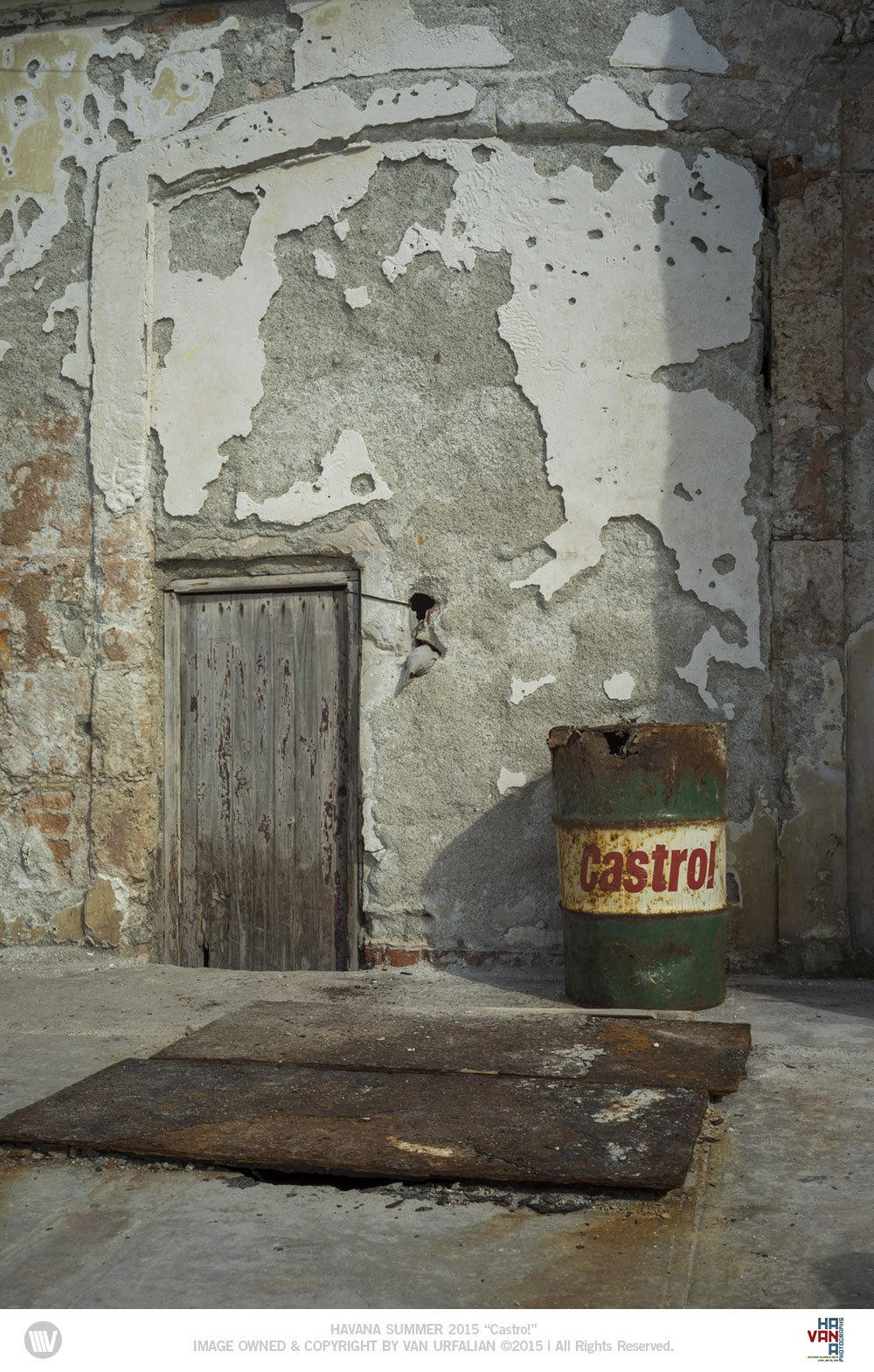
blurring the line between art and everyday life. A weathered door stands beside a rusted Castrol oil drum, its faded lettering reading like a shout of the president’s name.—turning a found object into an accidental monument. Fishermen stand shoulder to shoulder along the Malecón, fishing from the same seawall that doubles as an open-air gallery. A narrow lane lined with mint-green tenements remains a bastion of daily life, undisturbed by the growing
presence of artists and cameras. Havana Summer 2015 moves between architecture and people, between the
grandeur of decay and an unremarkable Tuesday, capturing both as authentic expressions of the city’s character.
The work is observational rather than journalistic—patient and attentive to the light, color, and texture of a city forced to endure rather than renew itself.
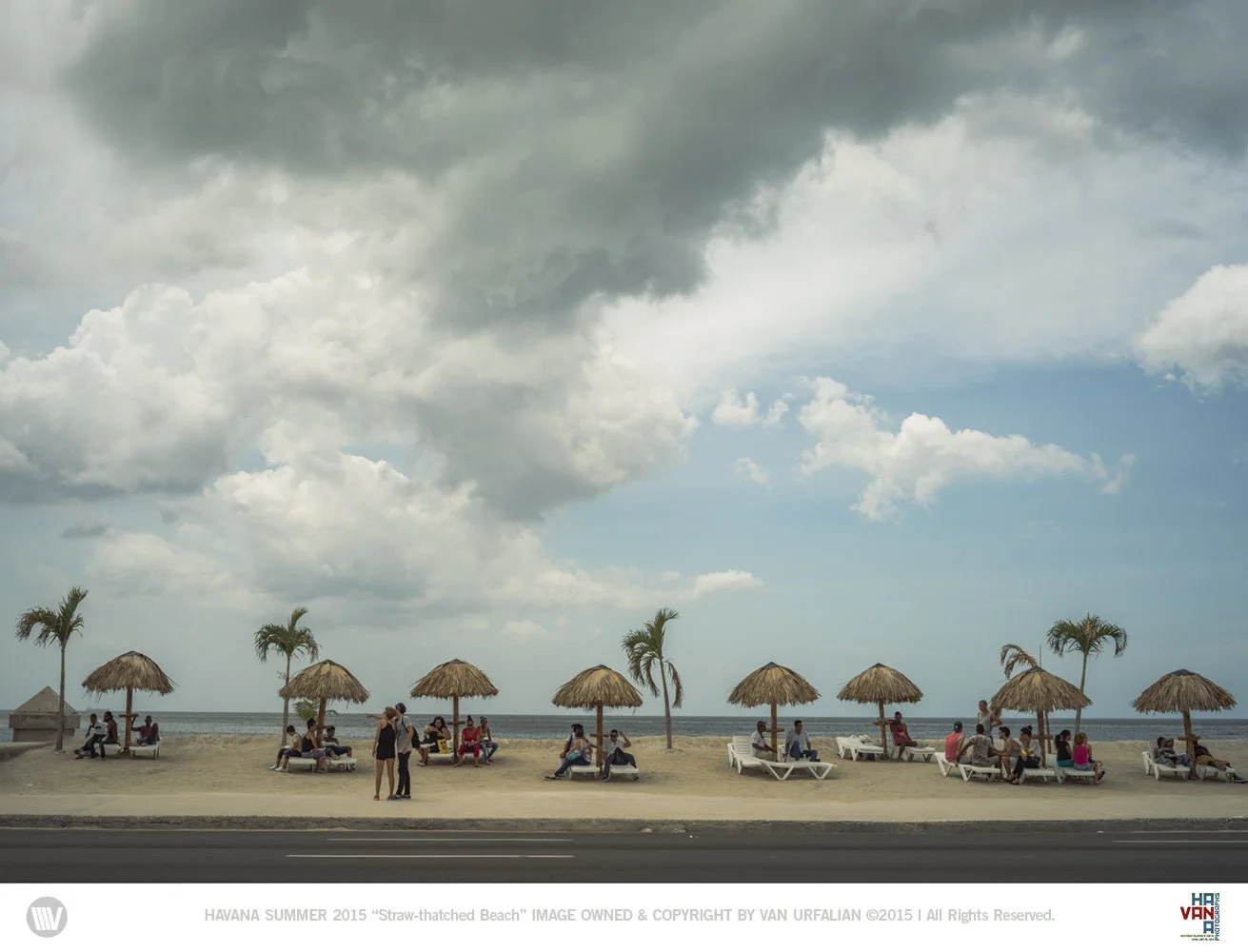
“Straw-thatched Beach”
This is Resaca (“Undertow”), a 2015 installation by Arlés del Río — a self-taught artist born in Havana in 1975 who has become one of the island’s most recognizable contemporary names, known for conceptual work built from everyday, often humble materials. Del Río assembled the piece from tiki huts, palm trees, beach chairs, and sand, turning a stretch of the Malecón into a real, functioning beach for roughly the month it was on view. It was one of fifty-one artists’ works in “Detrás del Muro” (“Behind the Wall”), the outdoor public-art exhibition curated by Juan Delgado Calzadilla, staged alongside the 12th Havana Biennial. The installation sat on the same stretch of seawall where the U.S. Interests Section had been located since 1953, days before that building reopened as a full U.S. Embassy — and since the sea has long functioned as a border most Cubans cannot cross, the beach’s deck chairs were reportedly arranged facing away from the water rather than toward it, turning a whimsical, almost absurd mirage of leisure into a quieter statement about who actually gets to use a beach like this, and how.
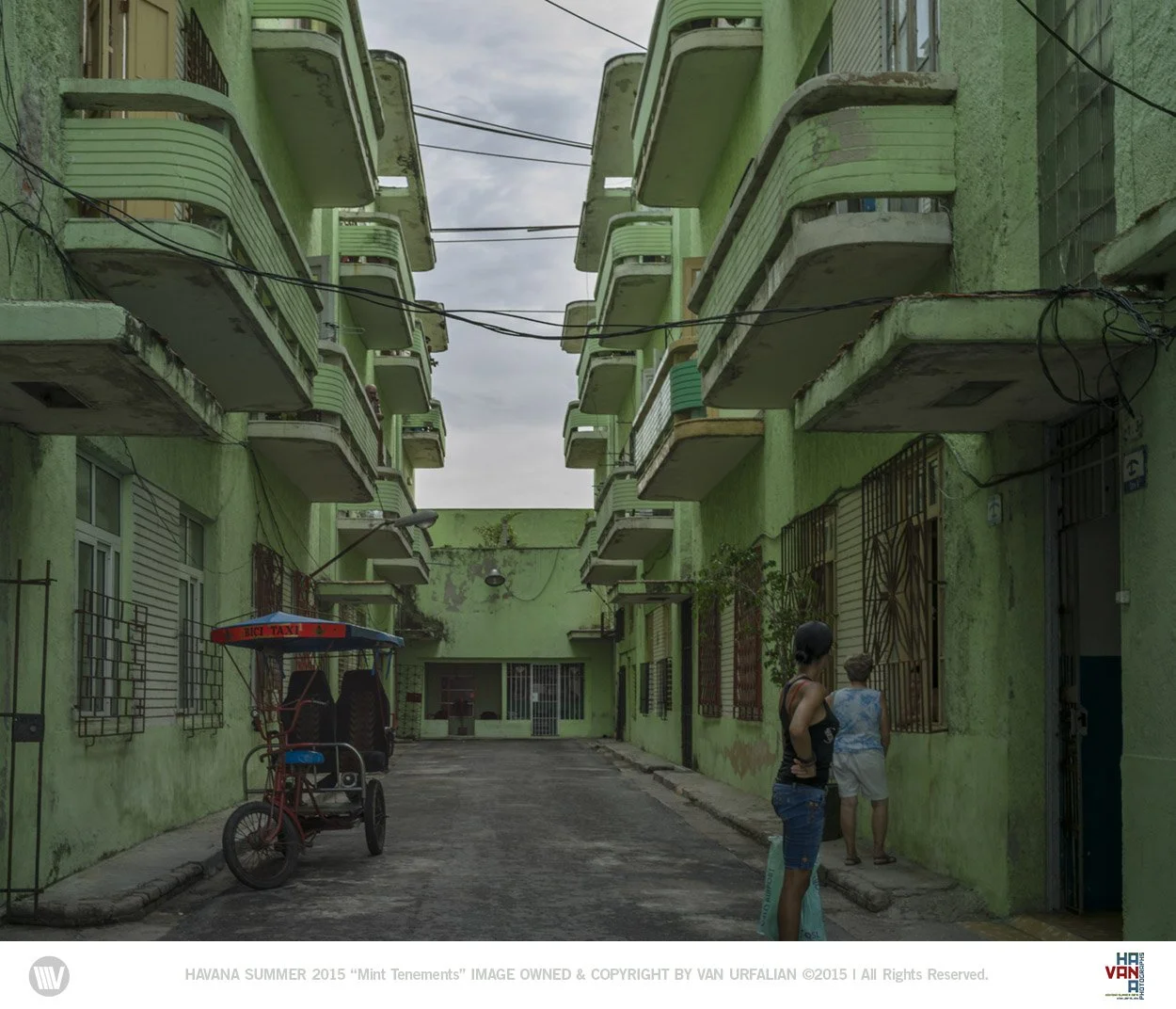
“Mint Tenements”
A stretch of Havana’s mid-century housing boom rather than its colonial core — reinforced-concrete apartment blocks from the 1940s and ‘50s, built for the city’s rising middle class, their cantilevered balconies stacked in identical rows down a narrow service alley. Six decades on, the paint has softened to mint, the wiring runs wherever it can, and iron security grates cover the ground floor windows, but the buildings still hold the rhythm of ordinary residential life — a bici-taxi waiting at the mouth of the alley, neighbors mid-conversation on the walk home. It’s a quieter, more overlooked Havana than the postcard version: not a landmark, just a place people live.
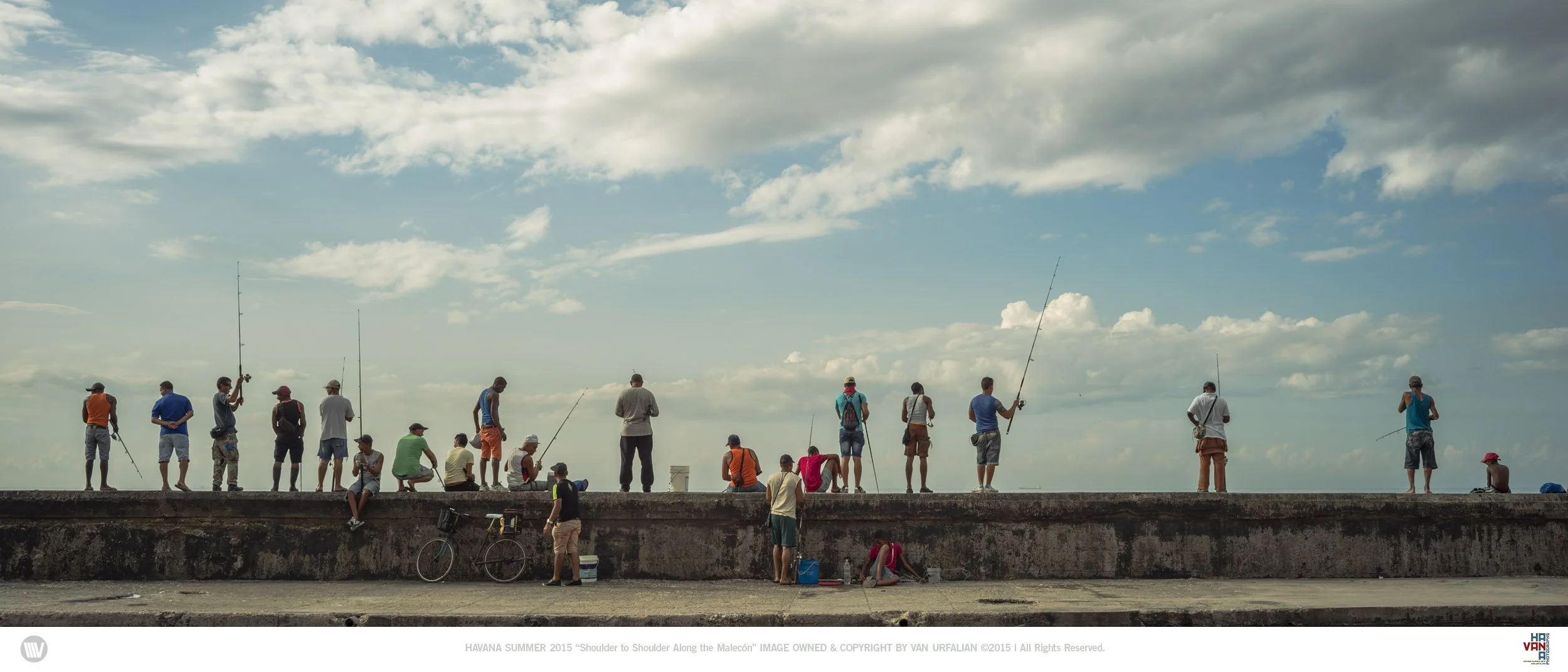
“Shoulder to Shoulder Along the Malecón”
A row of men working the same stretch of sea wall, rods angled out toward open water, spaced almost evenly like figures in a frieze. For most Cubans this isn’t recreation — private boats are tightly restricted, largely out of fear they’ll be used to reach Florida, so the wall itself has become the only fishing ground most people can reach, worked with hand lines, bicycle parts, and buckets rather than boats or proper tackle. What they pull in supplements a diet that’s grown leaner over the decades. Seen from a distance, it reads as ritual: a line of solitary figures, all facing the same horizon, doing the same quiet, necessary work.
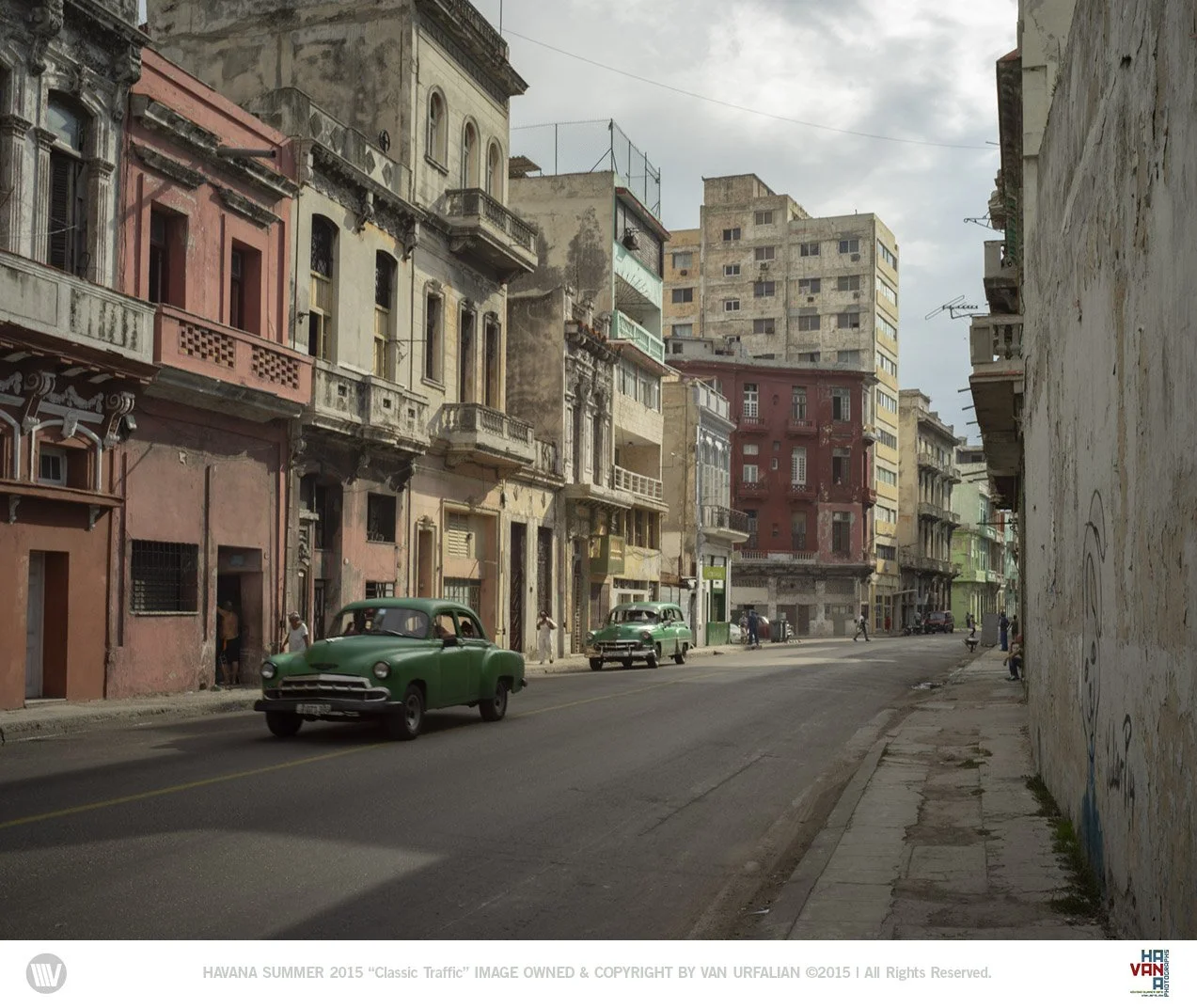
“Classic Traffic”
Two almendrones — the vintage American sedans Cubans call “big almonds” for their rounded shape — roll down a street that stacks nearly a century of Havana architecture into one sightline. These cars have outlived the country that built them: after the 1959 revolution cut off all imports of American parts, Cuban mechanics kept them running for decades on improvised fixes and Soviet engine parts, passing them down inside the same families rather than replacing them. For most of that time it was even illegal to buy or sell one freely. What looks like a postcard of old Havana is really a portrait of endurance — machines and the people who refuse to let them stop.
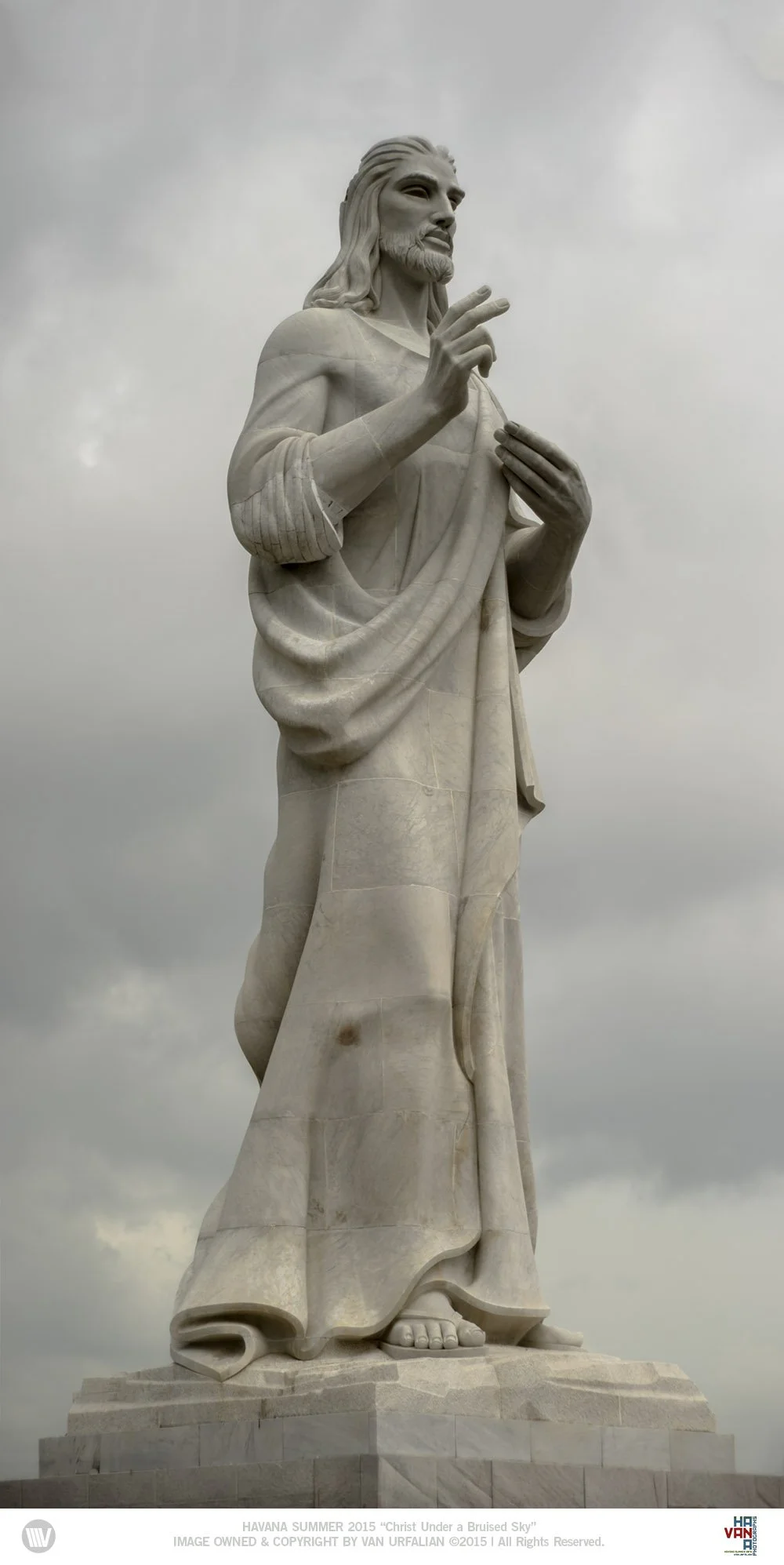
“Christ Under a Bruised Sky”
Officially known as El Cristo de La Habana — the Christ of Havana — this 20-meter figure was sculpted in Rome by Cuban artist Jilma Madera from 67 blocks of white Carrara marble, commissioned by Batista’s wife as a vow after he survived an assassination attempt, and inaugurated on December 24, 1958, just two weeks before his government collapsed. Madera left the eyes hollow so the statue seems to watch whoever is watching it, and in the decades since — struck by lightning three times, left neglected under military restriction for over thirty years before finally reopening to the public in the 1990s — it has quietly outlasted the regime that built it, and become one of Havana’s most enduring symbols in the process.
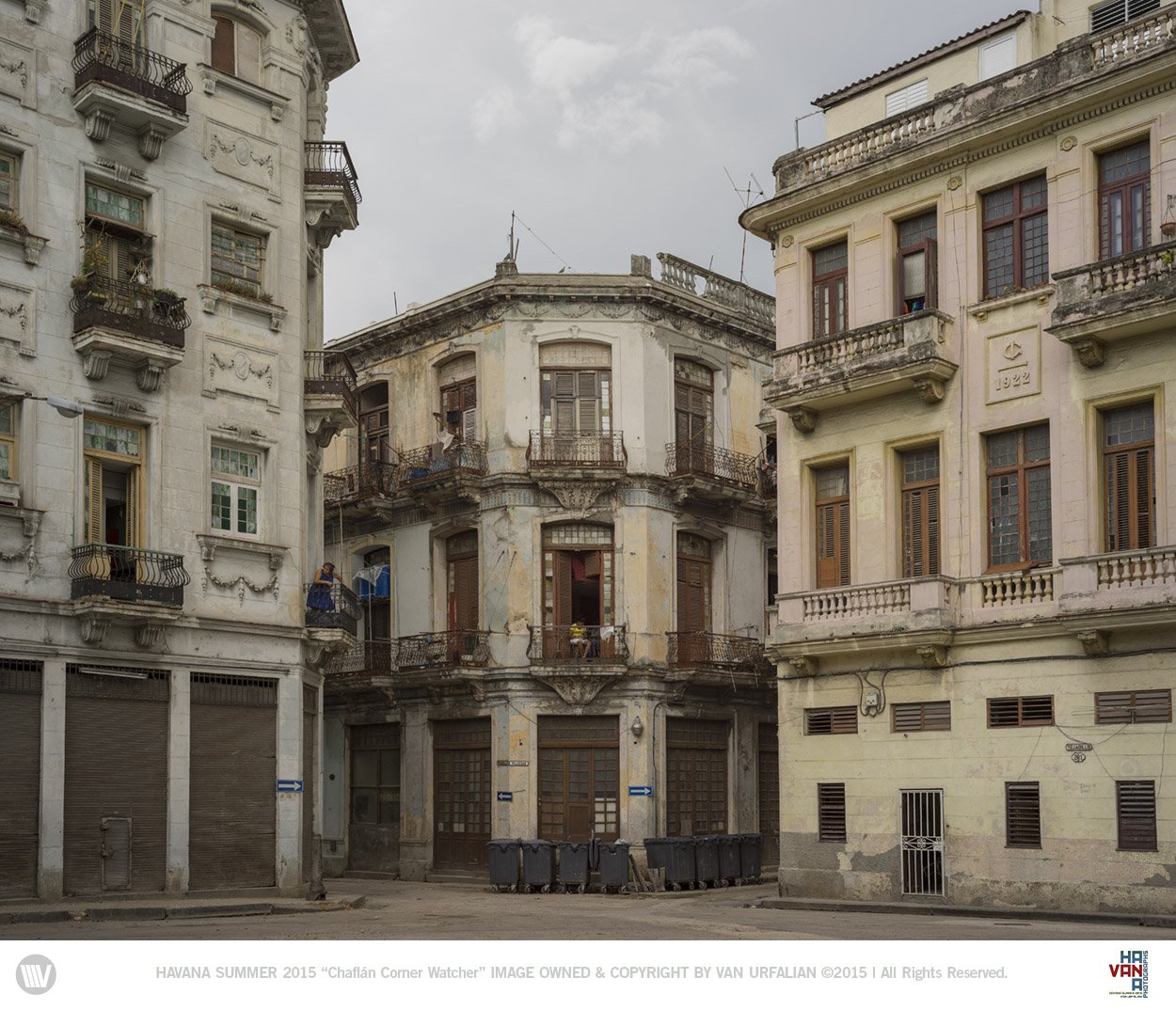
“Chaflán Corner Watcher”
The woman in blue on the upper balcony is doing what women all over this neighborhood do for hours at a time — standing at a railing, tracking the street below with more patience and consistency than any camera. In Havana’s older neighborhoods, these balconies function as a kind of informal watch system: someone is almost always home, almost always positioned at a window or ledge, and very little happens on the block without being seen and, eventually, discussed. It’s partly a byproduct of how these buildings actually live now — grand single-family townhouses long since divided into apartments for extended families, several generations sharing hallways, plumbing, and a single set of eyes on the corner. The laundry strung along the railings, the plants crowding a windowsill, the quiet routine of someone just sitting and watching — that’s daily life here, running in plain view, one balcony at a time.
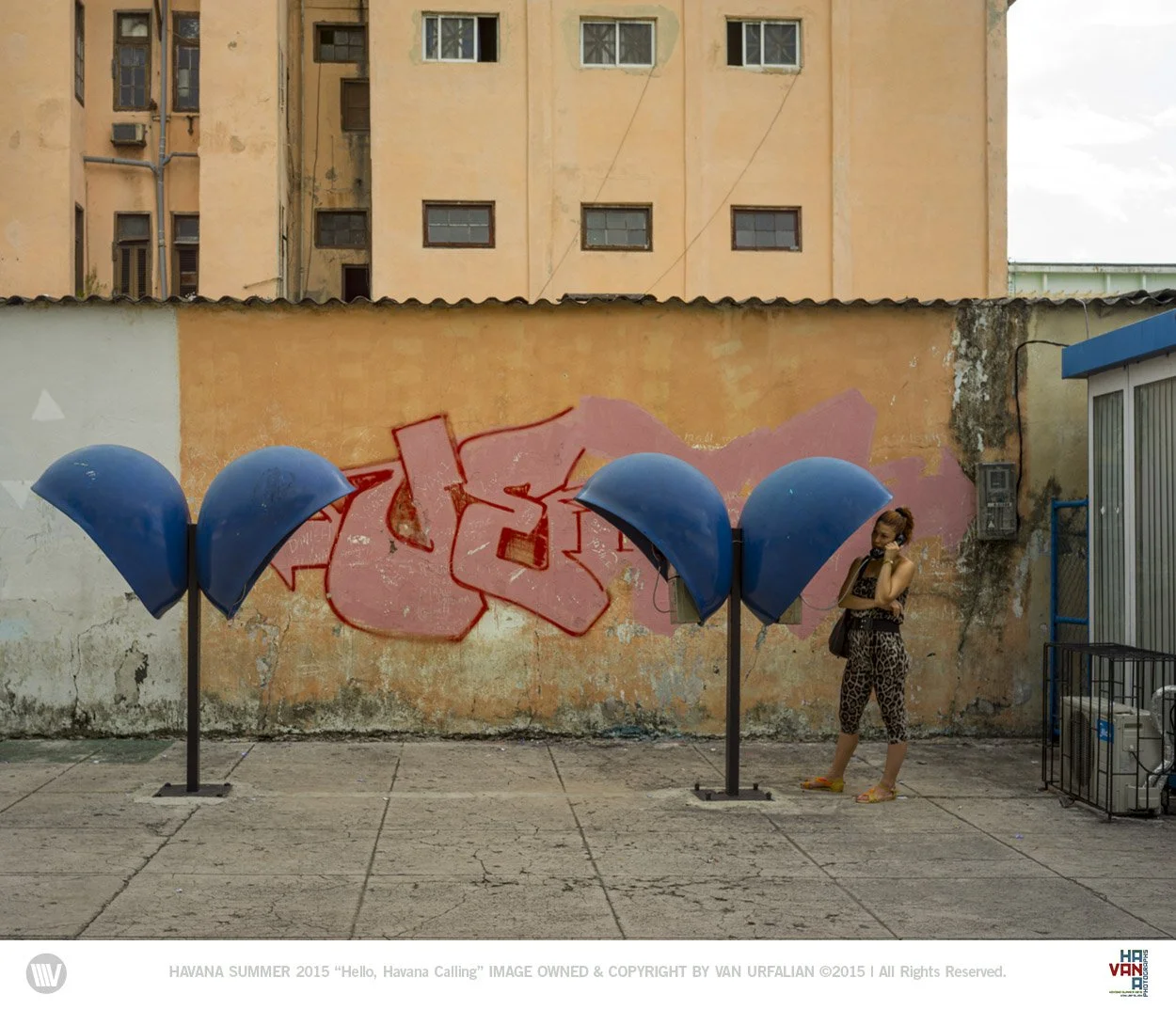
“Hello, Havana Calling”
A woman makes a call from one of ETECSA’s blue-shelled public payphones — standard-issue across the island, and in 2015 still the ordinary, practical choice for a huge share of Cubans, since cell service remained expensive on state salaries even years after phone ownership was legalized. Calls like hers carried extra weight that year: for over a decade, any call between Cuba and the United States had to route through a third country, making the connection slow and costly, until a direct phone link between the two nations was finally reestablished that same year, 2015, as part of the broader thaw in relations. A simple phone call, caught at the exact moment Havana was just starting to talk to the outside world a little more easily.
“Castro!”
Look closely at the barrel: it reads Castrol, not Castro. Castrol is a real, century-old British motor-oil brand — founded in 1899 by Charles “Cheers” Wakefield as CC Wakefield & Co., with the name itself a contraction of “castor oil,” the ingredient Wakefield’s chemists added to make their lubricant work across a wider
temperature range. The company was later folded into Burmah Oil, and BP acquired Burmah-Castrol in 2000. A rusted, decades-old Castrol drum turning up in a Havana courtyard isn’t unusual — Cuba has been running on salvaged, secondhand, and re-purposed machinery for 60+ years, so old imported oil drums outliving their original supply chain by decades is completely in character for the city.