
On the Road with Che
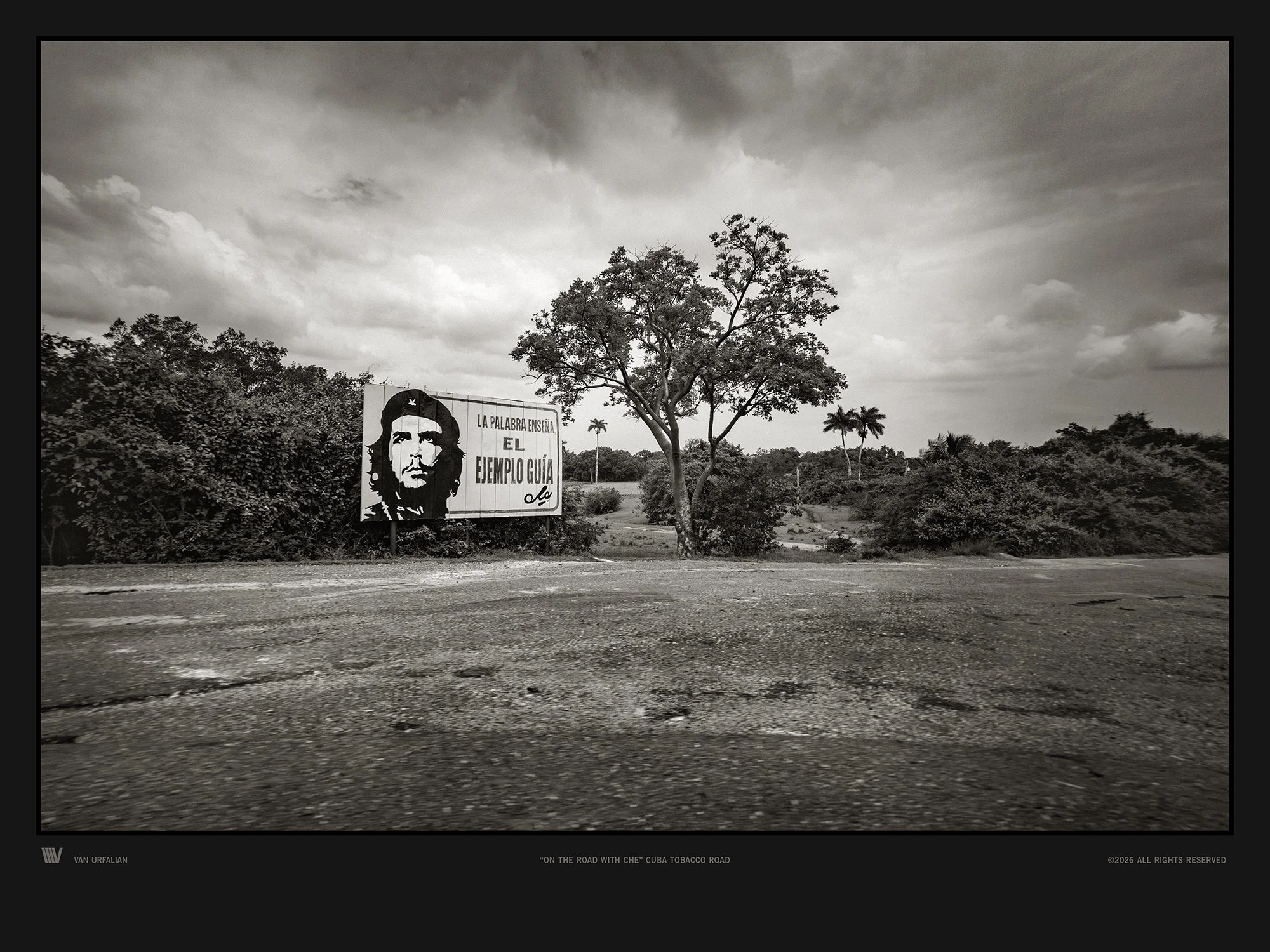
On the Road with Che
A painted billboard stands in a clearing, Che Guevara's stenciled portrait beside the words "La palabra enseña, el ejemplo guía" — the word teaches, example guides. Cuba has almost no commercial advertising; along its roads, billboards carry the Revolution's heroes and slogans instead. Out here, among fields worked by hand, there are few people to read it and no products to sell, and the line lands differently. In a valley where the work is learned by doing, it reads almost as a description of the farming as much as a slogan.
CUBA TOBACCO ROAD
Van Urfalian
Two hours west of Havana, in Pinar del Río province, the Viñales Valley is a landscape unlike any other in Cuba: farmland broken by mogotes, steep limestone hills that rise like islands from the valley floor, some as tall as 300 meters. In 1999 UNESCO designated the valley a World Heritage cultural landscape, in large part because of what happens on that floor — tobacco farming that has survived largely unchanged for centuries, still worked with animal traction because machines can compromise the quality of the leaf. The harvest is hung to dry in thatched barns for months, then sold under a system built on limits: farmers sell most of their crop to the state at a set price and are left a smaller share to sell on their own. It is craft shaped by patience and by constraint in equal measure.
Cuba Tobacco Road follows that valley through ten photographs. A farmer sits in the shade of his drying barn among hanging tobacco leaves. A thatched barn stands among banana trees at the end of a dirt path. A white horse waits beneath a tree, a vintage American car with peeling paint rests under the palms, and cattle graze beside an empty road. Behind it all the mogotes keep their distance, and in one frame a roadside billboard, Che Guevara's portrait beside the words "the word teaches, example guides," reminds the viewer which country this is. Where Havana Summer 2015 caught a city at a moment of change, these photographs are about what persists when change is slow to arrive — a place, a craft, and a way of working that have been built within limits and refined by them. Made in black and white, the work is observational rather than journalistic, patient with the light, the land, and the people who work it.
Van Urfalian grew up in Los Angeles and graduated from ArtCenter College of Design's photography program in 1999. He has worked as a photographer, cinematographer, and creative director for entertainment studios and global brands, building his career around the idea that a picture's job is to tell a story. Cuba Tobacco Road is the second showing of his Cuba work, following Havana Summer 2015, and like it, a step toward a book gathering the full series — the same instinct for composition and narrative applied without a client or brief, and the same fascination with what people make of what they are given.